Choosing fabric and building a palette
Updated 6th May 2026 4 min readA pile of fabrics you love individually will not necessarily make a quilt you love. The trick is not taste — it is method. Here is how to choose cloth that behaves, and combine colours that hold together across a whole top.
Start with the cloth itself
Quilting-weight 100% cotton is the standard for good reason: it is stable, takes a crease, presses flat and is forgiving to piece. It does not shift and stretch the way a fine lawn or a slippery synthetic does, which keeps your seams accurate. When you buy, check the weave is tight and even, and notice the grain — the threads running parallel to the selvedge (the finished edge) are the most stable, and pieces cut on that lengthwise grain will keep their shape best.
Buy a little more than a pattern states. Squaring up, the odd mis-cut and the wish to fussy-cut a motif all eat into yardage, and dye lots vary, so a small reserve of the same bolt is cheap insurance.
Think in value, not just colour
The most common surprise for new makers is that patchwork designs work because of value — the lightness or darkness of a fabric — more than because of colour. A pattern reads clearly when light, medium and dark fabrics are arranged with intent.
It turns to mud when everything sits at the same value, however lovely the individual prints.
Lay your chosen fabrics out together and photograph them with your phone in black-and-white mode. Stripped of colour, the lights and darks jump out — and any fabric that vanishes into its neighbours tells you the contrast needs work.
A working method for a palette
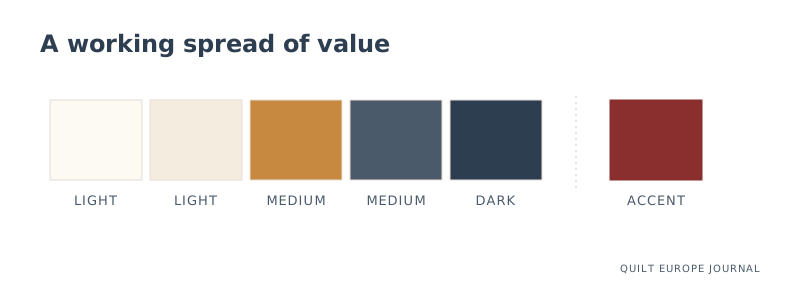
A reliable way to build a palette is to start from one multi-coloured "feature" fabric you love — a print with several colours in it — and pull your other fabrics from the colours it already contains. Because a designer has already balanced those colours, the palette inherits that harmony. Aim for a spread of value: a couple of lights, a couple of mediums, a deep dark to anchor it, and perhaps one brighter accent used sparingly.
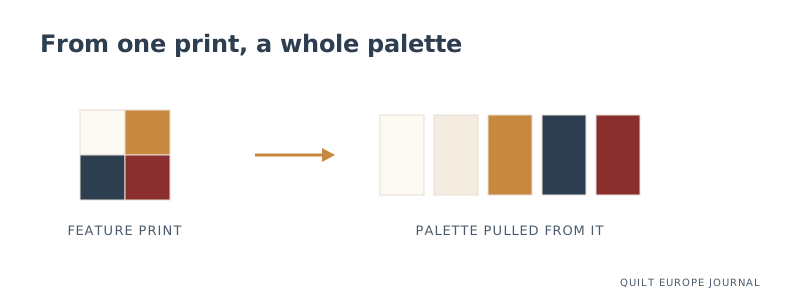
- Backbone fabric
- A multi-colour print to draw the palette from.
- Lights
- One or two — give the eye somewhere to rest.
- Mediums
- The working majority of most quilts.
- Dark
- One deep value to anchor and define.
- Accent
- A brighter or unexpected note, used in small doses.
European traditions, regional palettes
It is worth remembering that colour in quilting carries regional history. The deep indigo-and-white of much Northern European work, the warm madders and ochres of older folk textiles, the bright clear palettes of contemporary Nordic design — these are not arbitrary. Looking at the quilts in our gallery, or at the work shown at the festivals we cover in events, is one of the best ways to train your eye for combinations that go beyond the obvious.
Once your palette is settled, the rest is craft. If you have not yet pieced a block, build your confidence on your first nine-patch first — it is far easier to judge colour once you can predict how a seam will behave.